


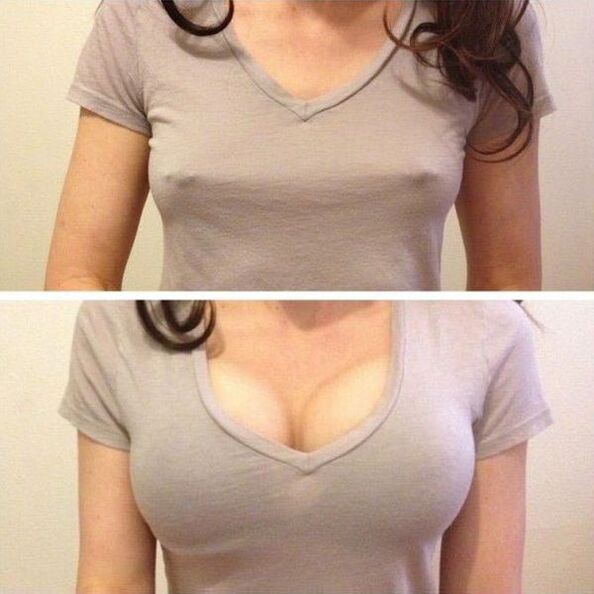
If you go out on the street and ask ten men why they need plastic surgery, many will answer without hesitation: "To enlarge women's breasts."This logic is not accidental: human civilization, whether the ladies like it or not, is fundamentally patriarchal, that is, men dominate almost everywhere.For them, the torso is the most attractive part of a woman's body.
Therefore, since ancient times, ladies, in order to make a stronger impression on the stronger half of humanity, have invented various ways to make their breasts more prominent.First it was dresses with plunging necklines, then underwear that created useful optical effects.But these were all temporary measures and women wanted something permanent or at least long-term.
Only the development of plastic surgery helped women to look truly in accordance with their desires and meet the standards of external beauty set by men.In 1889, something happened that millions of beautiful ladies around the world dreamed of - a method of artificial breast enlargement was invented, which later became known as breast endoprosthetics (from the Greek words "endon" - "inside" and "prosthesis" - "addition, union").
The first material used to enlarge female breasts was paraffin, which was originally called petroleum wax, as it was made from this flammable liquid.In the first decades of the last century, aesthetic medicine tried many materials that were suitable for endoprosthetics: ivory and glass beads, polyethylene and polyurethane, polyester foam and much more.All this led to sad consequences.
Only in 1961, two American plastic surgeons from Houston, Thomas Cronin and Frank Gerow, produced and used the first silicone implants during surgery, making a real advance in aesthetic medicine.But it took more than half a century before fifth-generation implants were invented in the mid-1990s. They are distinguished by improved physical and chemical characteristics: they are denser and more reliable;The gel that fills them is very stable and therefore does not flow through the shell.
Phases of operation
Since breast replacement is a serious surgical procedure, it is performed only under general anesthesia.During the entire operation, all the body's vital indicators are monitored using special monitors: blood pressure, heart rate, blood oxygen saturation level, etc.
Before the operation, the surgeon places marks with a special marker, according to which the surgical approach is then performed.The incisions are usually made so that the postoperative scars are minimally visible.The choice of surgical method depends on a number of determining factors.In particular, these are:
- the position (high, middle or low) of the mammary glands on the chest wall;
- the presence or absence of breast ptosis - ptosis and its degrees (there are three in total);
- skin features: thickness and elasticity, presence of stretch marks;
- anatomical characteristics of the muscles of the pectoralis major, sternum and ribs.
Then a pocket (bed) is formed for placing the implants.It can be placed under the pectoralis major muscle, under the mammary gland or a combined option is performed.The first method is used more often because it provides a more stable result.
After installing the implants, the wound is sutured.To achieve the best cosmetic effect, intradermal cosmetic sutures are applied using modern absorbable suture material or special medical glue is used.The patient is then placed in compression garments to prevent displacement of the implants and increased tissue swelling after surgery.For several hours after the operation, the patient stays in the rehabilitation ward, where her condition is monitored by the medical staff.
In general, breast replacement surgery takes between 40 minutes and an hour and a half.Sometimes it takes longer depending on the surgical technique used and a number of other factors.For example, a patient's desire to enlarge her breasts by several sizes at once.In addition, if you have previously had breast reconstruction surgery after breast cancer or trauma, the procedure may be more difficult and take longer.
Operating methods
There are four main surgical approaches used worldwide.
- Submammary (under the mammary gland).
This method involves cutting the skin just under the breast (in the submammary fold), which, if there is a well-formed fold, makes the incisions invisible.In other cases, this approach does not provide sufficient cosmetic results.The advantages of this approach include the fact that when it is used, the breast tissue is practically not affected. - Periareolar.
With this approach, the incision is located along the lower semicircle of the areola, at the border of the pigmented skin of the areola and the unpigmented skin.Because of this, after a few months the postoperative scar becomes almost unrecognizable.In this case, the breast tissue is distributed in the lower part.This does not in any way prevent the possibility of breastfeeding in the future and, contrary to common misconceptions, does not reduce the sensitivity of the nipples in the post-operative period. - Axillary (axillary).
This surgical approach involves making an incision in the armpit region.It also does not affect the breast tissue.The use of the method is more justified when the initial size is very small and the inframammary fold has not been formed.In other cases there are restrictions.To achieve axillary access, video endoscopic technology is required.It allows the operation to be performed in a safer and less traumatic way, given the distance of the incision from the operation area. - Transumbilical.
This is a rarely used technique.It involves installing an implant through an incision in the navel area.In this way, only an implant filled with saline solution can be placed.First the implant shell is placed and then filled.Such breast implants are practically not used, since, as experience has shown, silicone implants allow one to achieve a more stable result, taking into account all the nuances of a particular case.
The final choice of implant installation method and surgical approach depends on the characteristics of each patient, and only an individual selective approach for each case allows you to achieve the most aesthetic result.
Preparation for surgery
Before starting preparations for surgery, the patient must learn from the plastic surgeon all aspects of the planned procedure: the type of implant, the manufacturer, the availability and duration of the guarantee, the shape, the type of shell and the filling.The most common currently in the world are silicone implants with a textured shell and filler - silicone gel with shape memory.
There are different types of implantable fillers.
- silicone fluid, the consistency of which resembles vegetable oil;
- Standard silicone cohesive (cohesion is the bond between the molecules of a substance, which determines its strength) gel, with a jelly-like consistency;
- silicone gel with a high degree of cohesion, the consistency of which resembles marmalade;
- silicone gel "soft touch" (from the English "soft touch") - increased softness;
- saline solution, the consistency of a bag filled with water;
- soybean oil, similar in consistency to the first filler.
Each filler has its own advantages and disadvantages.For example, a highly cohesive gel retains the intended shape well with a high level of projection, but is denser to the touch.A saline solution makes the breasts feel as soft and natural as possible, but does not ensure the preservation of their shape.8-10 months after the start of use, salt crystals may begin to form that can pierce the shell.
In addition, there is a "gurgling" effect, which also does not suit all patients.
There is another way to enlarge the breast without the use of foreign materials.This is the introduction of fat cells - lipofilling or lipomodeling.This method was proposed relatively recently, in 2004, although similar experiments have been carried out since the second half of the twentieth century.However, in those years, fat implantation did not have a positive effect, as it was quickly absorbed by the body.
Today, plastic surgeons have learned to process fat cells in such a way that the effect of their injection lasts longer.Despite this, after a year and a half, up to 60% of the transplanted tissue volume is absorbed, so the operation will have to be repeated.Thus, unlike silicone implants, lipofilling is a temporary measure.
Before breast augmentation surgery, the patient will have to undergo a complete medical examination to ensure that there are no medical contraindications and to minimize potential risks.It will include:
- blood tests: clinical and biochemical, for coagulation, for Rh group and factor, for HIV, syphilis and hepatitis C and B markers;
- general analysis of urine.
In addition, mammography or ultrasound of the mammary glands, chest x-ray or fluorography, electrocardiogram and ultrasound of the veins of the lower extremities will be required.In addition, during a consultation with a plastic surgeon, the patient must be told about all existing diseases, previous operations, allergic reactions, as well as medications taken, including dietary supplements.
Also, before the operation, you will need to stop smoking and drinking alcohol for at least two weeks, since the first has a bad effect on healing, and the second is not compatible with antibiotics, which are prescribed for prophylactic purposes in the postoperative period.
In addition, every woman planning mammoplasty should know and take into account the fact that planning a pregnancy within a year after the operation is extremely undesirable.The fact is that changes in hormonal levels in the early postoperative period and the beginning of the lactation process (formation of breast milk) can affect breast implants in the most unpredictable way.
Contraindications for performing breast endoprosthetics are:
- pregnancy;
- diabetes mellitus;
- severe endocrine and autoimmune diseases;
- blood coagulation disorder;
- diseases of the mammary glands (including mass formations), which require observation by an oncologist;
- worsening of existing chronic diseases;
- diseases of the cardiovascular and respiratory system that serve as a contraindication to general anesthesia;
- age less than 18 years;
- less than six months after stopping breastfeeding.
Rehabilitation after surgery
Full recovery after breast replacement occurs within a few months.This period can be divided into several main phases.
During the first 3-4 days after surgery, patients may experience discomfort: heaviness and bursting sensation in the pectoral muscle area.They can be relieved by taking analgesics prescribed by the attending physician.On the fourth day, these manifestations usually go away.
Swelling of soft tissues in the surgical area is possible.Sometimes it lasts for several weeks and spreads to the abdominal area.These are normal symptoms and should not be cause for concern.
Hand movements will be limited for the first 24-48 hours after the procedure.
During the first week you should not drive.During this time, it is best to keep the clothes as comfortable and easy to remove as possible.
You will need to limit physical activity as much as possible.However, bed rest is not necessary at all.Avoiding nicotine and alcohol is also strongly recommended.
A week after the operation, you can already drive a car, but only if you do not take painkillers, which seriously impair motor skills.It is important to consult your surgeon before returning to driving.
If your work does not involve intense physical activity, then returning to work is possible within a week.However, you should avoid lifting heavy objects (more than 4-5 kg) and refrain from excessive physical activity.
One month after surgery, your doctor will likely allow you to resume light exercise.However, most surgeons still do not recommend doing a lot of upper body work during this period, especially involving the pectoral muscles.Light cardio exercises are possible without running or swimming.Around this time, you will begin to see the results from the breast augmentation.The breasts will begin to fall into their natural position and take on a more natural shape.However, please note that this process may take several months.Four weeks after surgery, the compression garment is usually removed and you can start wearing an underwire or push-up bra.
A few months after surgery, you will be able to see if the results are as expected.As for the scars, they will continue to gradually fade over time and blend into the surrounding skin.They should become virtually invisible within a year if properly cared for.Two to three months after surgery, the breasts become softer, regain the consistency of natural breast tissue, and then become increasingly softer every month.After three months, you can start more intense upper body exercises.
There are some other post-surgery tips you can use to speed up your recovery:
- avoid taking medications that affect blood clotting;
- moisturize your mammary glands regularly to avoid stretch marks;
- suppress the desire to remove the bandages and watch the progress - this can provoke an infection;
- give your implants time to "fit": at first they will look unnatural, with an overly full upper post, but gradually they will take on a natural teardrop shape;
- make sure you get plenty of rest as this speeds up the recovery process;
- Avoid wearing tight clothing, especially those that require you to lift your arms up when putting them on;
- For a month after the operation, you should only sleep on your back!You can't sleep on your side, much less on your stomach.In the first days it will be easier to sleep with pillows placed high behind the back;
- if you have severe pain, asymmetric swelling appears or the bandage is wet, consult a doctor immediately;
- Don't worry if you have increased or decreased sensitivity in your nipples after surgery: this is normal;
- sensations on the right and left may not be the same - this is not a sign of trouble and happens to almost everyone;
- Please note that most women can breastfeed after surgery, however milk production may be slower.